About
Author: Maria Dermoût
(Indonesia)
Genre: Domestic
Setting
Place: Maluku Islands, Indonesia
Time: 1800s-1940s
My Rating (see what this means)
My Subjective Rating: 4
My ‘Objective’ Rating: 3.67
Introduction
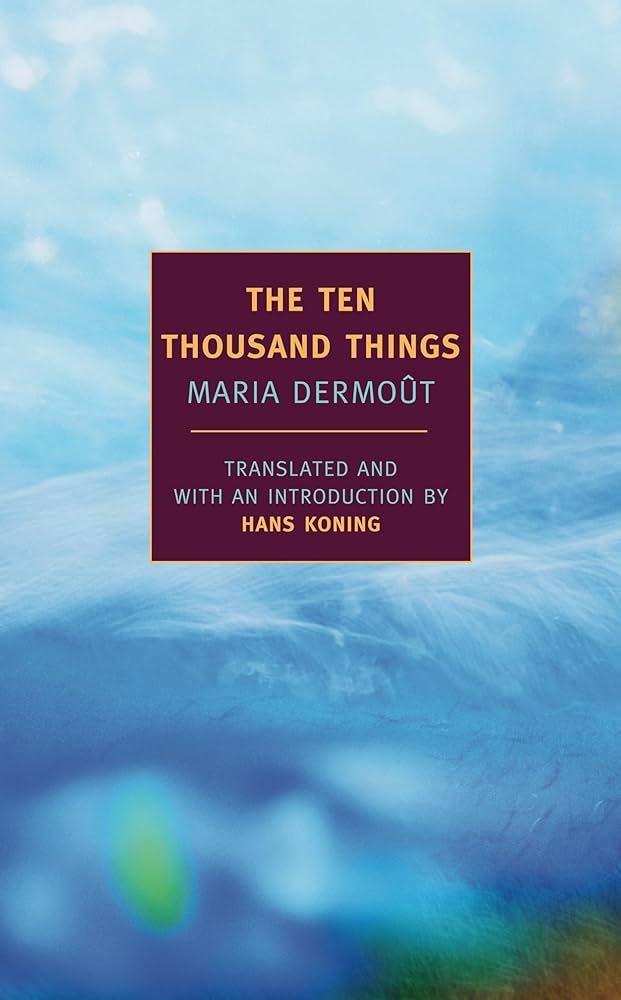
‘The Ten Thousand Things’ by Maria Dermoût has several parallels with some of my favourite books – the Elizabeth-Hardwick-Maggie-Nelson-Renate-Adler-adjacent ones. For instance – Hardwick’s book – ‘Sleepless Nights’ about the – distorted memories of a broken old woman in a squalid nursing home – can with a few adjustments be used to synopsize Dermoût’s Ten Thousand Things. It is after all the distorted memories of a broken old woman in a haunted spice garden.
There is a lot of sorrow in each of these books. A melancholic overhang runs throughout. But none come off as sad books per say. Each after all – captures all the eventfulness and uneventfulness of a beautiful life. Also, there is a strong autobiographical element in a lot of these books – and it becomes, at times difficult to tell the protagonists and the author apart. (Dermoût, just like the protagonist, grew up in Indonesia, and had lost a son to a war)
‘The Ten Thousand Things’ is a marvellously well written book, beautifully descriptive of the imagery of the Moluccas (Maluku islands) where it is set and is wonderfully empathetic. The Ten Thousand Things – also despite a very unique narrative structure and a barebones story, is more easy to classify as a conventional novel than a piece of Adler’s or Nelson’s writing.
Synopsis
The Ten Thousand Things is a story of a Dutch girl Felicia as she grows up with her grandmother on an island in the Moluccas in colonial Indonesia and of Felicia, now herself of grandmother age going on living amidst the ghosts of people who died before they were supposed to.
Review

The core strength of the book comes from its writing and how beautifully it describe the landscape and the lives of the people living in it. That is a sufficient enough reason to read the book. It is a dense work demanding the reader’s attention and is engaging enough to hold it.
Built on a barebones story – for nothing much happens in the book, it is structured uniquely – section one sets the landscape, section two – talks in detail about the life of the protagonists and her family, section three then abruptly turns into a collection of very distantly connected short stories. And all these merge seamlessly back into the main story arc in the final chapter. The protagonist Felica as well as the several other characters are well developed and engaging throughout.
And is there a point to the story? Yes and no – however much Felicia hates talks without finality.
In a sense – it is a ponderance on loss and life –
They couldn’t say to her (Felicia), “you must try and get over it,” that made her furious, “do you think we should get over each other,” she asked, “is that what you think? “Without love, without loyalty, without memory — cowards!” she would mutter afterward.
Felicia had a special deep and burning pity for those who had been murdered – her son happened to be one among them. The book is a lament for them – the hundred things of which the dead one is reminded, which are asked him, told him.
And then as she ponders these lives and her own, she realises –
They weren’t a hundred things but much more than a hundred, and not only hers; a hundred times “a hundred things,” next to each other, separate from each other, touching, here and there flowing into each other, without any link anywhere, and at the same time linked forever . . .
And one can ponder these on and on but understanding it was perhaps not need, wasn’t possible. One after all has to try to go on living.
Picture Credits:
- Cover Picture: https://javaprivatetour.com/johanna-bezoet-de-bie-the-dutch-woman-who-loved-javanese-fashion
- https://seawatersports.com/places/goa/tropical-spice-plantation-in-goa