About
Author: Vladimir Lorchenko (Moldova)
Genre: Socio-Political
Setting
Place: Moldova
Time: 2000s
My Rating (see what this means)
My Subjective Rating: 2
My ‘Objective’ Rating: 2.27
Introduction
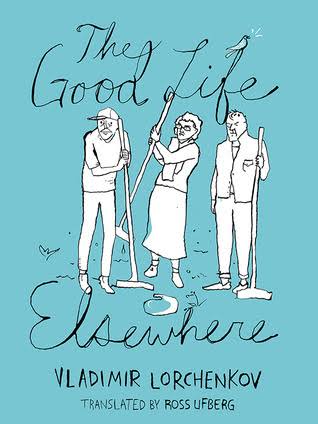
‘The Good Life Elsewhere’ by Moldovan writer Vladimir Lorchenkov is a biting satire about one of Europe’s poorest peoples and their doomed attempts to migrate in search of—just as the title suggests—a “good life elsewhere.”
The novel centres on the citizens of a small northern Moldovan town called Larga, who are consumed by the dream of Italy as a promised land. Their obsession leads to a series of absurd, almost cartoonish schemes to escape their bleak reality. At the heart of the story is Serafim, the only villager who supposedly speaks Italian—though it turns out to be Norwegian—serving as both a comic anchor and a symbol of misplaced hope. Around him, the townsfolk emerge as vivid, eccentric characters, each devising increasingly ridiculous plans to flee their misery.
Though framed as dark humor, the novel’s tone often tilts more toward darkness than comedy. For me, the satire sometimes felt too heavy to be genuinely humorous, blurring the line between laughter and despair. [I explore this tension in more detail in the discussion below.]
Discussion
Is the book too dark to be funny – or I just can’t appreciate dark humour?
A few reasons I feel the dark humour didn’t work –
Lack of Contextual Grounding: The novel rarely pauses to explain why Moldovans are so desperate to migrate. Without that grounding, it is difficult to grasp the stakes in the book, so the humor felt hollow or detached.
Truth vs. Absurdity: While exaggeration and absurdism are essential for good dark humor, I feel truth is a critical element for it to work.
- Situations rooted in reality — like people selling organs to escape poverty — resonated because they echoed actual reports from Moldova. They were brutal, but believable.
On the other hand, the president faking a plane crash to migrate felt cartoonish. Without a clear sense of desperation, it read as farce rather than satire.
Instead – the author could have focused on some of the absurd reality of Moldova – for instance – several politicians in Moldova – including a president have publicly supported Moldova merging with Romania]
Gross-Out Factor: Some episodes leant into grotesque imagery that overwhelmed the humor. Instead of laughing at the absurdity, I recoiled, which broke the satirical effect. For instance – when a character leaves his dead-from-accidental-suicide wife hanging because he is still pissed at her.
Mixing Genres: The novel blends dark humor with elements of magic realism (flying tractors, swimming tractors). While inventive, this mash-up can dilute the satire, making it harder to tell whether the author wants us to laugh, wince, or marvel.
That is not to say that the book was always unfunny. It had a good amount of good parts but overall the narrative choices felt unideal.